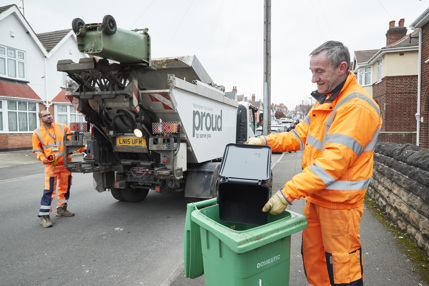
 Nottingham City Council has been given until 2030 by the government body Defra (Department for Environment, Food, and Rural Affairs) to start weekly food waste collections across the whole city. This is because starting any sooner would create significant cost pressures for our current waste disposal contract.
In March 2023, we began collecting food waste in the Berridge area to help us learn what works before we expand the service citywide. We are now speaking again with households in Berridge to get their feedback, understand any problems, and find out what would help more people use the service.
We are also looking at how to collect food waste from flats and buildings with shared bin areas. To do this, we’ll be working with partners to test practical solutions so that we can offer a good service for everyone.
Before we can roll out food waste collections across the whole city, we need enough external funding to do this. To avoid unnecessary costs for the city, our current focus is on learning as much as possible from collections in Berridge and running more tests in flats and communal buildings to address operational questions.
We’re planning ahead by working out how long it will take to get enough specialist food waste vehicles and caddies, and checking that our depot and collection routes are ready. This preparation will mean that we can start food waste collections citywide as soon as the funding is confirmed.
The best things to do with our food is to avoid waste in the first place. To discover some simple ideas to make the most of your food at home visit: www.lovefoodhatewaste.com
Berridge Food Waste Collections
Since 2023 Berridge residents have managed to prevent over 120 tonnes of food waste. Food waste collected is sent to a local anaerobic digestion plant, where it is used to produce biogas which is used as energy and fuel for vehicles. The organic material left over is used to create fertiliser for farming.
Separating food waste also means you have more space in your green residual waste bin for things you can’t recycle, and helps keep it fresh too.
If you live in the Berridge and don’t yet take part in food waste collections, you can check if you live on an eligible street and order a free food waste bin and kitchen caddy using the contact form at the bottom of this page.
Berridge Food Waste Collections FAQs
Two food waste containers are provided; a small indoor kitchen caddy (7 litre) to keep inside, and a larger food waste bin (23 litre) to keep outside and store the food waste for collection.
The food waste is collected weekly on the same day as your residual waste and recycling bin, this is a Friday in the collection area. Place your outside food waste bin at the kerbside before 7am on your collection day. Your food waste is collected by a separate food waste vehicle, so will be emptied at a different time of day to your other bins.
You can put most forms of cooked and uncooked food in your food waste bin including:
- Leftover food from meals
- Fruit and vegetables
- Meat and fish including bones
- Rice, pasta and beans
- Bread, cakes and biscuits
- Solid dairy foods
- Eggs and eggshells
- Pet food
- Tea and coffee bags and grounds
Please do not put liquids, liquid fats, garden waste, straw or animal bedding, cut flowers or packaging of any kind in your food waste bin.
There is no need for your kitchen caddy or food waste bin to smell, attract insects or vermin. Here are some top tips to help keep your caddy fresh:
- Don’t put hot food items in your caddy, leave them to cool off first
- Squeeze tea bags and coffee grinds dry before putting them in your caddy
- Line your food waste caddy with kitchen roll or newspaper to help absorb excess moisture. You can use bags, with small, thin bags that would otherwise go in the bin such as bread or potato bags being ideal
- Sprinkle a little baking soda at the bottom of your caddy to neutralise odours
- Keep the lids closed and make sure your food waste bin handle is in the locked position with the handle pushed forward, to seal it tight
- Store your food waste caddy and bin away from direct sunlight or heat
- Empty your caddy regularly and put your food waste bin out for collection each week, even if it’s only partially full
- Rinse out your caddy and bin regularly
Food waste bins are collected weekly, on the same day as your recycling or residual waste. Check your collection day here.
We are sorry if your presented food waste bin has been missed. If your food waste caddy has not been collected, please let us know as soon as possible.
- If you report a missed collection by 5pm, two days after your scheduled collection day we will return to collect your caddy within 2 working days.
Example:
If your collection day is Friday, you must report it by 5pm on Sunday. We will return to collect on either Monday or Tuesday.
- If you report your missed caddy after this deadline, we will not be able to return before the next collection. Your caddy will be emptied on your next scheduled collection day.
If needed, place excess food waste in your green (residual) bin to prevent overflow.
To help avoid missed collections, place your food waste bin where it can be easily seen. Putting it on top of your other bin out for collection can also help.
Check that your bin only contains items allowed in the food waste bin.
Once collected, food waste is taken to the Biodynamic Anaerobic Digestion plant in Colwick, where it produces biogas and fertiliser.
The food waste is turned into a slurry and put in sealed tanks. Bacteria inside the tanks digest the food waste, a bit like the stomach of a cow, turning it into biogas which can be used as energy and fuel for vehicles. The leftover organic material becomes fertiliser, going on to help produce even more food whilst reducing the need for chemical fertilisers.
You can find out more about the plant by watching this video:
Food waste that isn’t recycled doesn’t rot down harmlessly, it releases greenhouse gases into the atmosphere that contribute towards climate change. By recycling your food waste, it goes from being a problem to get rid of, to being a resource that can help tackle issues our society faces today.
Free compostable liners were initially provided to half of the households in the collection area to see if they improved the quality and amount of food waste collected. We have now stopped providing them because many residents chose not to use them, and they do not work well with anaerobic digestion.
These types of biodegradable bags are mainly designed for composting, not anaerobic digestion, so they must be removed before the food waste can be processed. Instead of creating new single‑use bags, it’s better to reuse small, thin plastic bags you already have, such as bread, potato or frozen food bags. Please avoid thick bags like ‘bags for life’, black bin liners, or leaving food in hard plastic containers. Waxed paper caddy liners are suitable if you prefer.
The most environmentally friendly option is not to use any bags. See the How do I keep my food waste caddy and bin fresh and clean section for tips that may help you go bag‑free.
Yes, of course. You should only compost garden waste, uncooked waste vegetables and fruit (e.g. peelings and skins) as well as coffee grounds and tea bags.
All non-compostable food waste, such as meat, fish, small bones, cooked food and dairy products can go into your food waste bin.
For information and advice about how to compost at home visit our website here.
If you live in the Berridge collection area you can reorder a replacement kitchen caddy or external bin free of charge if it is lost, stolen or damaged. You can order these using the ‘Get in Touch’ button at the bottom of the page.
You may also like to clearly number your food waste bin, to avoid confusion amongst your neighbours and so crews know which property to return it to.
Contact Us
Contact us
Contact Us OnlineTake our website survey
Please take a few moments to complete our survey and help us improve your experience.
Website Survey